On this page
Record what you can do: the resistance you use, the repetitions you control and how familiar movements feel. Notice everyday changes too, such as carrying shopping more comfortably. Body weight can be one measurement, if you want it, but it cannot tell you how strong you are.
What should you track besides body weight?
Choose a few observations that matter to your goal. For a strength goal, note the exercise, resistance and controlled repetitions. For daily function, choose a familiar task you would like to find easier. Keep the comparison reasonably consistent rather than testing something different every week.
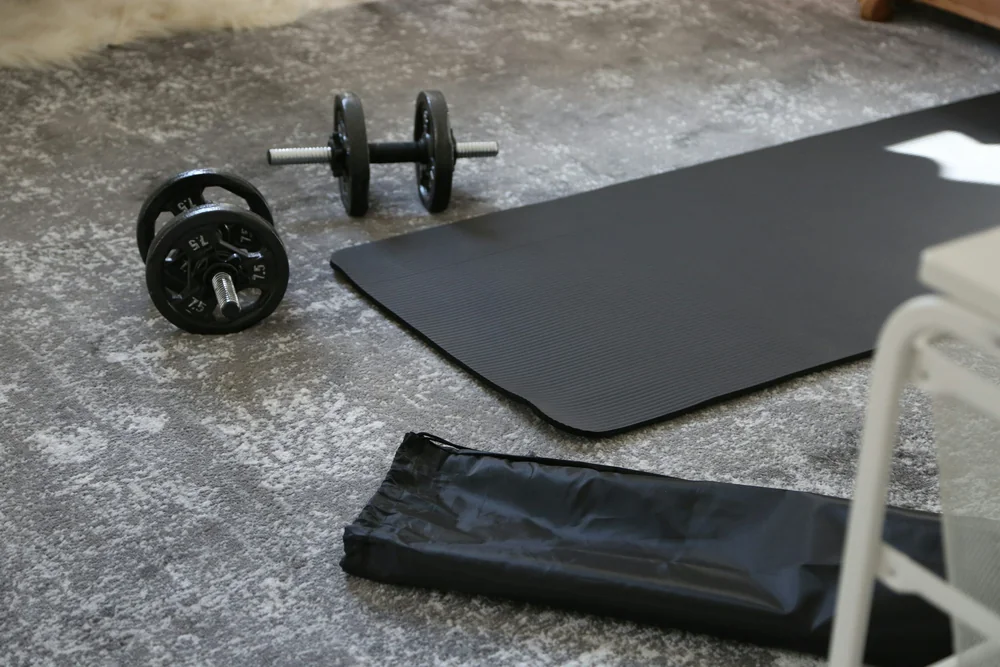
You might record: "Same dumbbells, two more controlled repetitions than last time." That is a clearer training observation than "I worked harder." Include the exercise variation, because a supported squat and an unsupported squat are different tasks.
Energy and confidence are worth noticing because they affect your experience of training. They are subjective, though, and can change for reasons unrelated to exercise. A difficult week does not erase the work in your log. WHO identifies health benefits of physical activity that extend beyond body weight, including sleep and mental health. WHO physical activity guidance
Why might the scale miss a change?
Weight is a total. It does not separately report fat and muscle, and it does not measure movement skill. A systematic review of supervised resistance-based exercise in people with overweight or obesity found improvements in body composition, including increased lean mass with resistance training alone. Systematic review of resistance training and body composition
Those study results are not a forecast for your body or a specific home program. An unchanged scale cannot prove that you gained muscle and lost fat. Equally, it cannot tell you that your training has failed. Use your exercise records to answer the strength question, and discuss body-composition goals separately if they matter to you.
When should you add repetitions or resistance?
Consider progressing when you can complete the planned movement with control and the current version is becoming easier. Ask a qualified instructor to help you judge that if you are unsure. Use feedback before changing repetitions or weight.
As a practical example, if your plan provides a repetition range, you could first work towards its upper end without losing technique. Then discuss a small resistance increase and return to fewer repetitions within that plan. Change one variable at a time so you can see how you respond. This is an illustration, not a universal progression formula.
Keep the workload unchanged when you are still learning the movement or cannot recover comfortably between sessions. Pain needs attention rather than an automatic increase. You do not have to add weight every week.
Can bands and light dumbbells keep helping?
They can be useful, but the challenge needs to fit your goal and current ability. ACSM recognises bands and home training as effective options, while noting that heavier loads can optimise strength development. ACSM resistance training guidance
If the equipment becomes easy for the planned work, you may need stronger bands, heavier weights or another suitable exercise variation. Heavier resistance is not inherently bad for women, and lighter equipment does not guarantee a particular body shape.
Review your notes periodically with your goal in mind. There is no guaranteed eight-week transformation. A prerecorded demonstration cannot assess your individual technique.
FROM READING TO PRACTICE
See how the method fits together.
Explore the open eight-week demo. Sample content only; training footage, final recipes and enrollment are still being prepared.
Explore the training demoFollow Natalia on Instagram